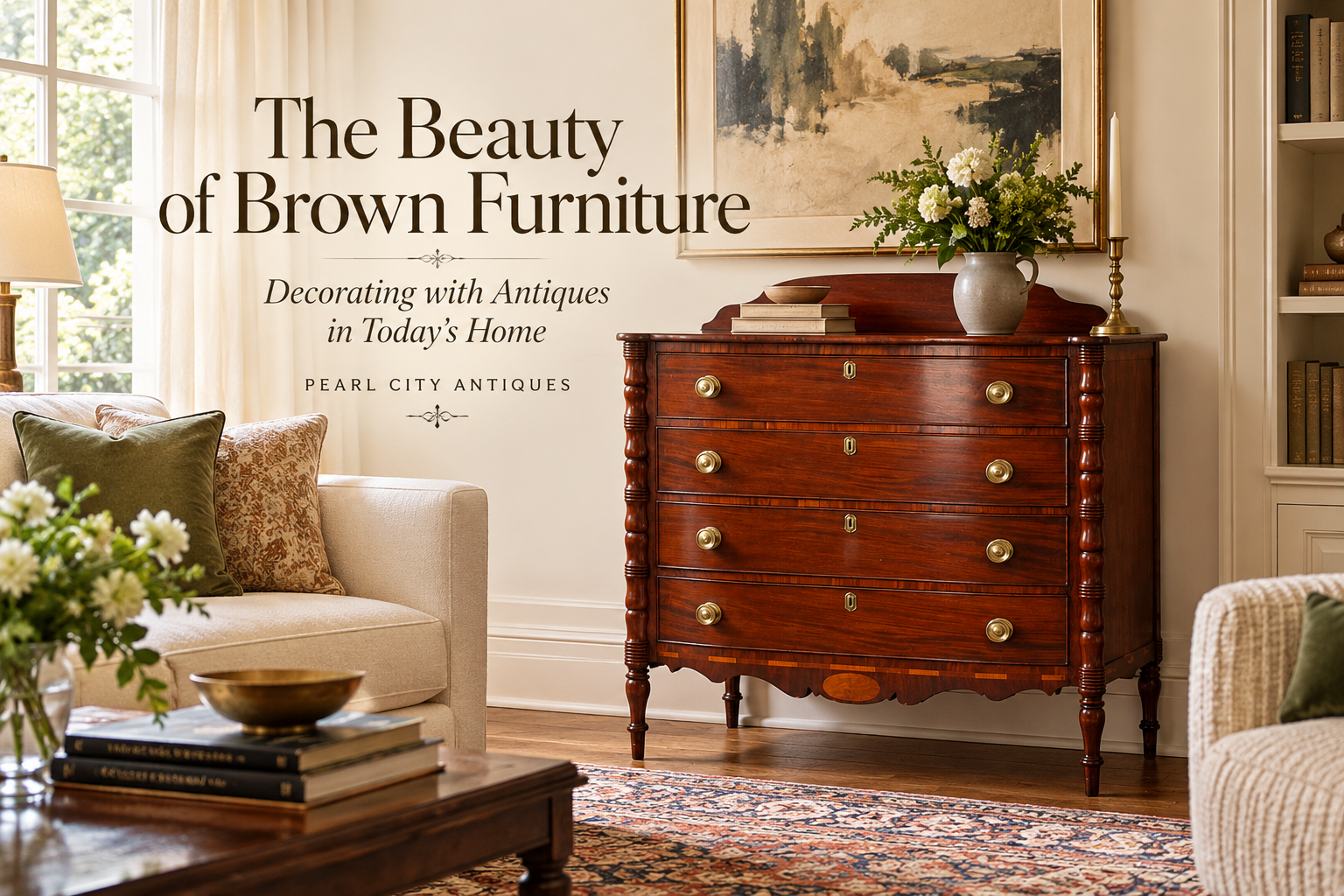
The Beauty of Brown Furniture: Decorating with Antiques in Today's Home
Featured image: AI-generated room setting for inspiration. Shop this antique New England Federal mahogany bowfront chest, c. 1820–1840.
How the warmth, craftsmanship, and character of antique furniture can bring depth and individuality to modern interiors.
There is something unmistakably beautiful about a room that has evolved over time.
Perhaps it's a richly figured mahogany chest beneath a contemporary painting, an eighteenth-century table surrounded by comfortable modern chairs, or a simple cherry stand positioned beside a well-loved sofa.
These are the spaces that tend to capture our attention. They feel collected rather than decorated, personal rather than prescribed.
And often, at the heart of these rooms, stands a piece of antique brown furniture.
For years, traditional wooden furniture was sometimes dismissed as heavy, dated, or unfashionable. The rich mahogany, walnut, cherry, and oak furnishings that once occupied nearly every American home gradually gave way to lighter finishes, painted furniture, and more contemporary designs.
But something important was overlooked in the process.
The best antique furniture possesses qualities that transcend decorating trends: beautiful proportions, remarkable craftsmanship, the warmth of natural wood, and a character that cannot easily be manufactured.
At Pearl City Antiques, we have long believed that these pieces deserve a place in today's homes, not simply because they are old, but because they are beautiful.
And perhaps the most compelling way to appreciate antique furniture is not to recreate the rooms of the past, but to discover how naturally it can become part of the present.
Why Brown Furniture Deserves Another Look
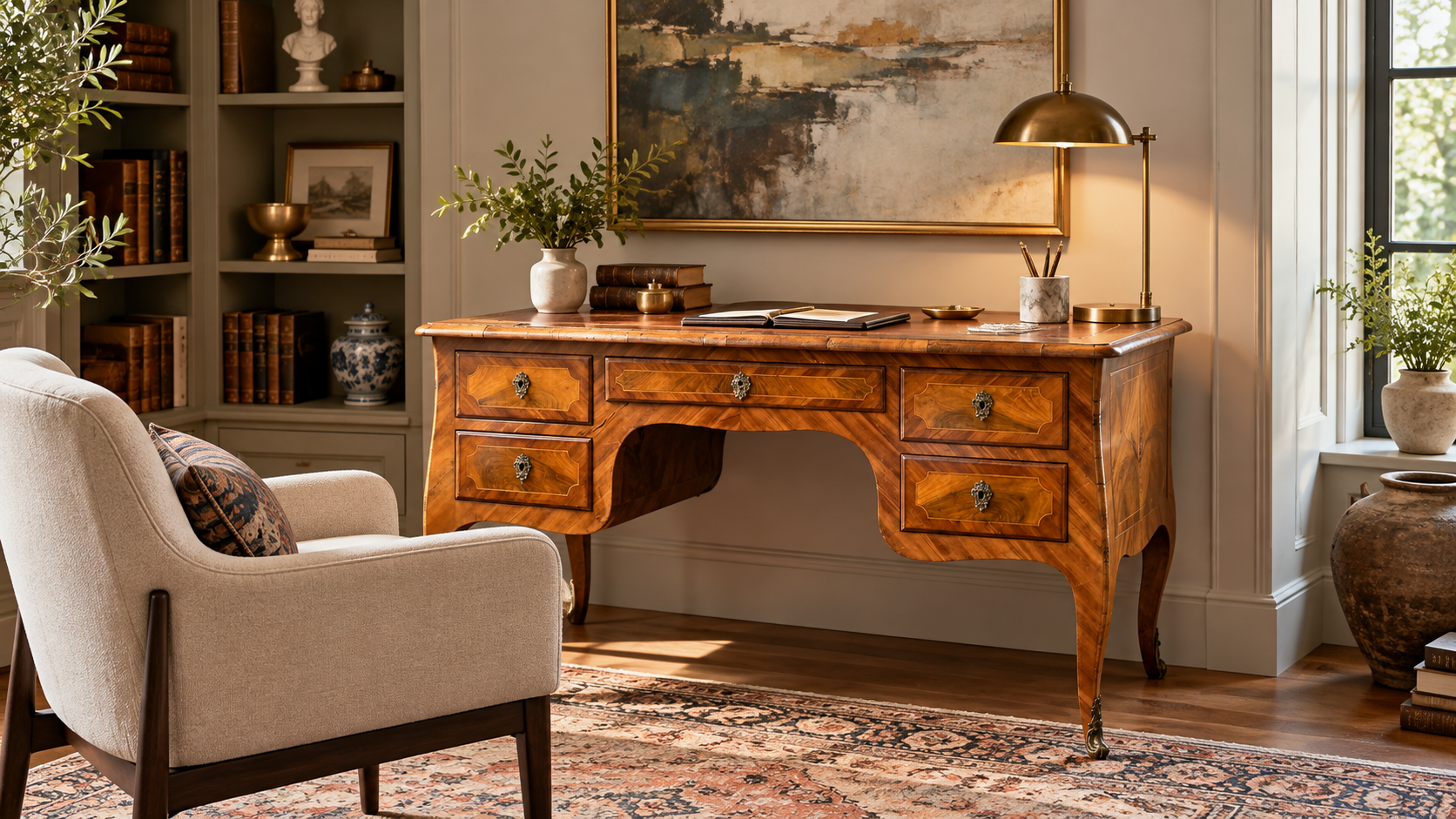
AI-generated room setting for inspiration. Shop this antique South German walnut marquetry writing desk, c. 1780.
The expression brown furniture has become a convenient shorthand in the antiques world for traditional wooden furnishings, particularly those made during the eighteenth and nineteenth centuries.
It is an admittedly unromantic description for objects that often represent extraordinary craftsmanship.
Consider a finely proportioned Federal cherry chest.
Its maker selected the wood, considered its grain, shaped its components, fitted its drawers, and created a piece intended to be both beautiful and useful. The cabinetmaker worked within an established design tradition but brought individual judgment and skill to every stage of construction.
Two centuries later, the furniture may still serve the same practical purpose.
That longevity is part of its appeal.
But the deeper beauty lies in qualities that are difficult to reproduce convincingly: the subtle irregularities of handmade construction, the mellowing of old surfaces, and the graceful proportions developed through generations of furnituremaking.
Mahogany offers rich color and dramatic figure. Cherry develops remarkable warmth and depth. Walnut can display beautifully varied grain, while oak brings texture and a sense of strength.
Each wood has its own personality.
When these materials are combined with thoughtful design and the passage of time, furniture acquires a visual richness that can become the defining element of a room.
The challenge is rarely the furniture itself.
More often, it is how we choose to surround it.
The Secret Is Contrast, Not Re-creating the Past
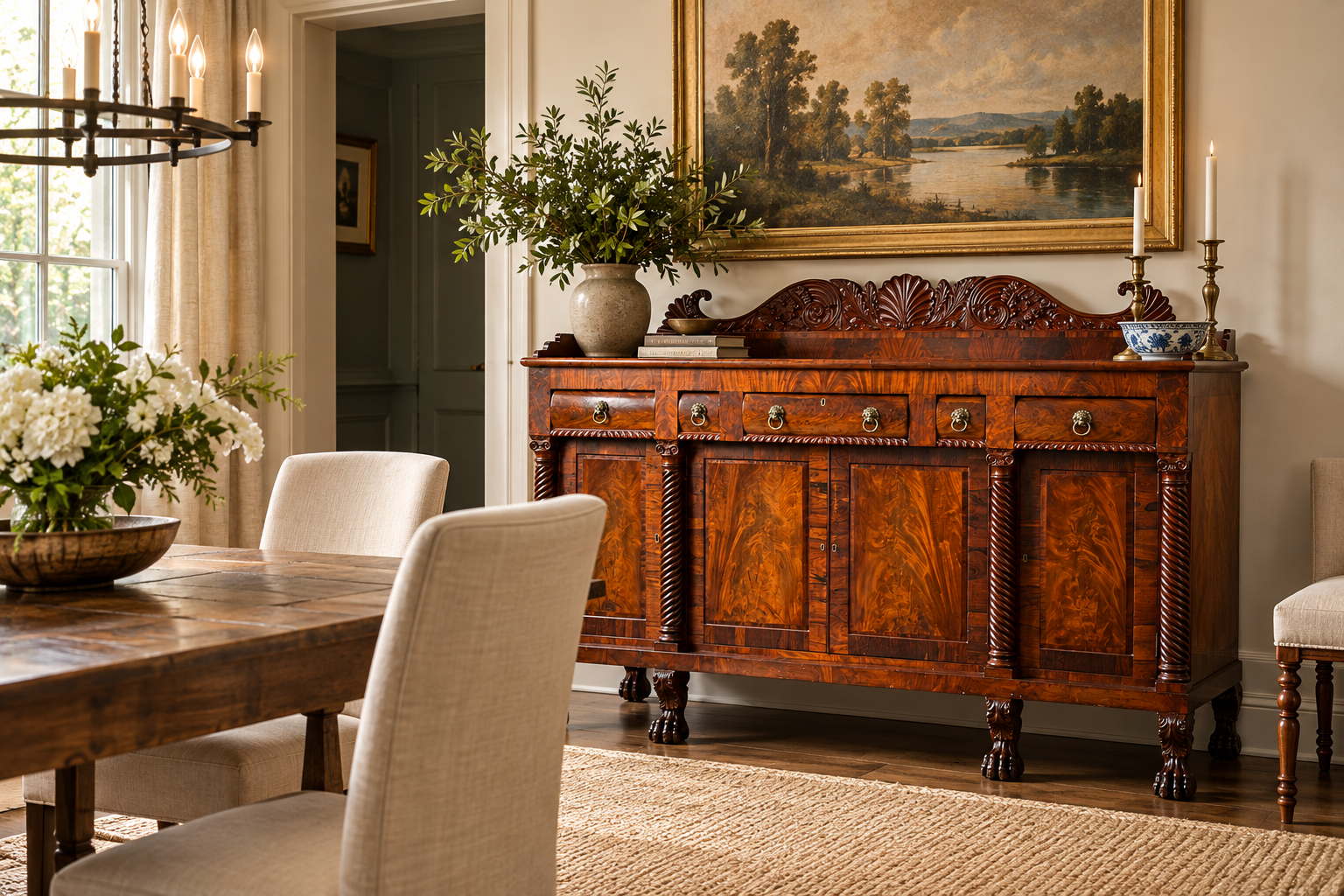
AI-generated room setting for inspiration. Shop this antique American Empire mahogany sideboard, c. 1840.
One of the most common misconceptions about decorating with antique furniture is that it requires an entirely traditional interior.
An eighteenth-century chest does not demand a room filled with eighteenth-century chairs, period portraits, and heavy draperies.
In fact, some of the most interesting interiors emerge when furniture from different periods is brought together thoughtfully.
Imagine an early American cherry chest placed against a softly colored wall, with a contemporary abstract painting above it.
The painting introduces a modern perspective, while the antique provides warmth, structure, and a sense of permanence.
Neither competes with the other.
Instead, the contrast allows both to become more interesting.
A Georgian mahogany table can work beautifully with upholstered dining chairs of simpler contemporary design. An antique secretary can bring architectural presence to a room otherwise furnished with understated modern pieces.
Even a modest early nineteenth-century stand can become a memorable accent when paired with contemporary lighting.
A piece such as our Antique New York Sheraton One Drawer Stand, c. 1800 illustrates the possibilities. Its historical character could bring a welcome contrast beside a modern upholstered chair or sofa.
The important consideration is balance.
When every object in a room announces the same historical period, the space may begin to resemble a carefully preserved interior rather than a home that reflects the people living in it.
But when antique furniture is allowed to coexist with pieces from other periods, the result can feel both sophisticated and remarkably comfortable.
A home does not need to belong to a particular century to benefit from the beauty of furniture made in one.
Let One Remarkable Antique Anchor the Room
A thoughtful room often begins with a single compelling object.
It may be a painting, a rug, an architectural feature, or a piece of furniture whose form and character immediately establish a sense of place.
Antique furniture is particularly effective in this role because its presence is often as much sculptural as functional.
A tall Georgian secretary can bring height and architectural interest to a library or living room. A beautifully figured mahogany chest can establish a sense of warmth in an otherwise restrained bedroom.
A substantial dining table may become the natural center of a room, grounding a mixture of chairs, lighting, and artwork.
We often encourage people to consider the piece itself before worrying about whether it belongs to a particular decorating style.
Does it have beautiful proportions? Is the wood attractive? Does it possess a sense of balance and craftsmanship? Can it serve a useful purpose in the home?
These questions are more valuable than asking whether the furniture matches everything else.
A room with one exceptional antique and a thoughtful collection of complementary furnishings can feel far more distinctive than one assembled entirely from matching pieces.
There is no need for every object to compete for attention.
Sometimes the most effective design decision is simply to give a beautiful antique the space it deserves.
Mixing Wood Tones with Confidence
Another reason people hesitate to incorporate brown furniture into contemporary interiors is uncertainty about mixing different woods.
Will a mahogany chest work in a room with oak floors? Can cherry furniture sit comfortably beside walnut? Must every wooden surface share the same finish?
Fortunately, the answer is generally much more flexible than people imagine.
Historic homes frequently contained furniture made from several different woods. Pieces were acquired over time, inherited, moved between rooms, and combined according to practical needs and personal taste.
Perfectly matching furniture was not always the objective.
The same principle works beautifully today.
Rather than attempting to match every wooden surface, look for harmony in undertones, proportions, and the overall composition of the room.
A warm cherry chest can complement lighter oak flooring. The deep color of mahogany may provide a pleasing contrast against pale walls or neutral upholstery.
Walnut and mahogany can coexist particularly well when their different grain patterns and color variations are allowed to provide interest.
The goal is not necessarily to make every piece identical.
It is to create a room in which the different materials feel intentional.
Textiles are particularly helpful. A patterned rug, upholstered chair, or natural linen curtain can soften the transition between different woods.
Paint colors also make an enormous difference.
Warm whites, muted greens, soft blues, and understated earth tones often provide beautiful surroundings for traditional furniture. Richer colors can work equally well, particularly when balanced with adequate light and less elaborate furnishings.
And occasionally, the most interesting choice is contrast: an antique mahogany chest against a surprisingly modern background.
Beautiful wood is remarkably adaptable when given the opportunity.
Scale and Proportion Matter More Than Style
One of the greatest strengths of eighteenth- and nineteenth-century furniture is its emphasis on proportion.
Cabinetmakers working in traditions such as Queen Anne, Chippendale, Hepplewhite, and Sheraton devoted considerable attention to the relationship between height, width, depth, and decorative detail.
These relationships help explain why well-designed antique furniture can remain visually compelling even when removed from its original historical setting.
A modest Federal stand may appear delicate and understated. A large English Georgian chest can have a commanding architectural presence.
Both can work in contemporary interiors, but they require different treatment.
When decorating with antiques, we recommend paying close attention to the scale of the furniture and the room in which it will be placed.
A substantial chest may benefit from an open wall with limited competing decoration. A slender table can be particularly effective in a narrow entryway or beside an upholstered chair.
The visual weight of a piece also matters.
Dark furniture may appear heavier when surrounded by other dark, substantial objects. The same piece can feel surprisingly graceful when placed against a lighter wall, complemented by simple accessories, and given adequate breathing room.
Before purchasing, consider the furniture's measurements, the surrounding architecture, and how people will move through the room.
An antique should feel comfortably situated, not forced into a space merely because it fits.
This is one of the reasons we place considerable emphasis on dimensions and clear product photography in our listings.
A beautiful piece deserves a location where its proportions can be fully appreciated.
Decorating Room by Room
The Living Room: Warmth and Individuality
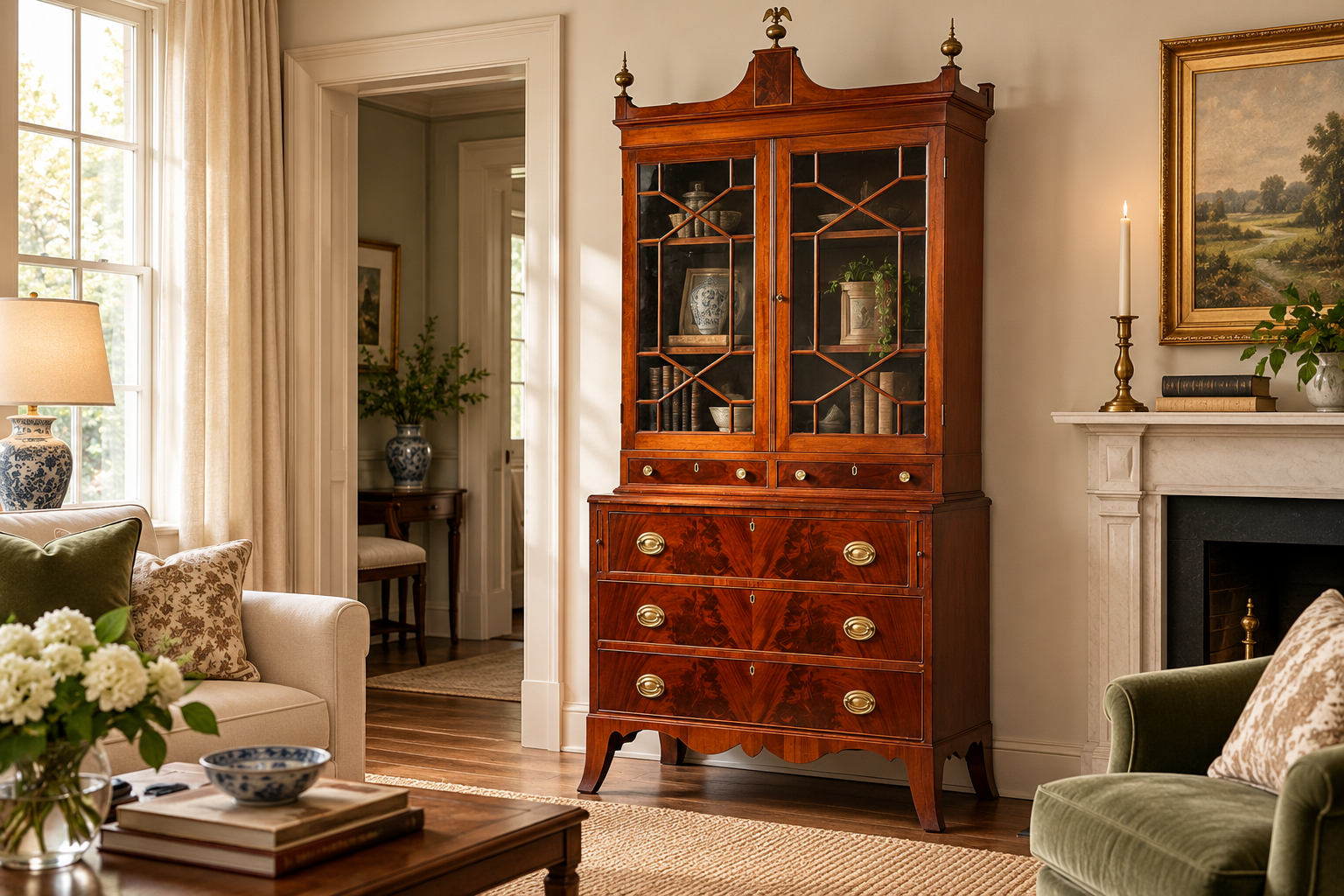
AI-generated room setting for inspiration. Shop this antique Federal flame mahogany secretary bookcase with eagle finial, c. 1810–1825.
A living room is an excellent place to begin incorporating antiques because it naturally accommodates furniture from different periods.
An antique chest can serve as a distinctive focal point beneath artwork. A small mahogany stand may function beautifully as an end table, while a period writing table can provide an interesting alternative to a conventional console.
Consider the effect of pairing a simple modern sofa with a richly figured antique table.
The upholstery introduces comfort and restraint, while the antique contributes warmth and craftsmanship.
A well-chosen oriental rug, contemporary lighting, and a mixture of art can help connect the different elements.
The result need not feel formal.
In fact, the contrast between relaxed upholstery and beautifully made traditional furniture can create an especially inviting interior.
The Dining Room: Old Furniture, New Traditions
Antique dining tables bring a particular sense of continuity to a home.
They were made for gathering, conversation, meals, and the small rituals of daily life.
A Georgian or nineteenth-century American dining table can be paired with chairs from another period or even with contemporary upholstered seating.
The combination can soften the formality sometimes associated with traditional dining furniture.
Likewise, an antique sideboard or chest can provide useful storage while introducing another layer of history to the room.
One need not own an entirely matched dining suite to create a cohesive space.
Indeed, a thoughtfully assembled collection can feel more natural and personal than a room furnished all at once.
The Entryway: Making a Memorable First Impression
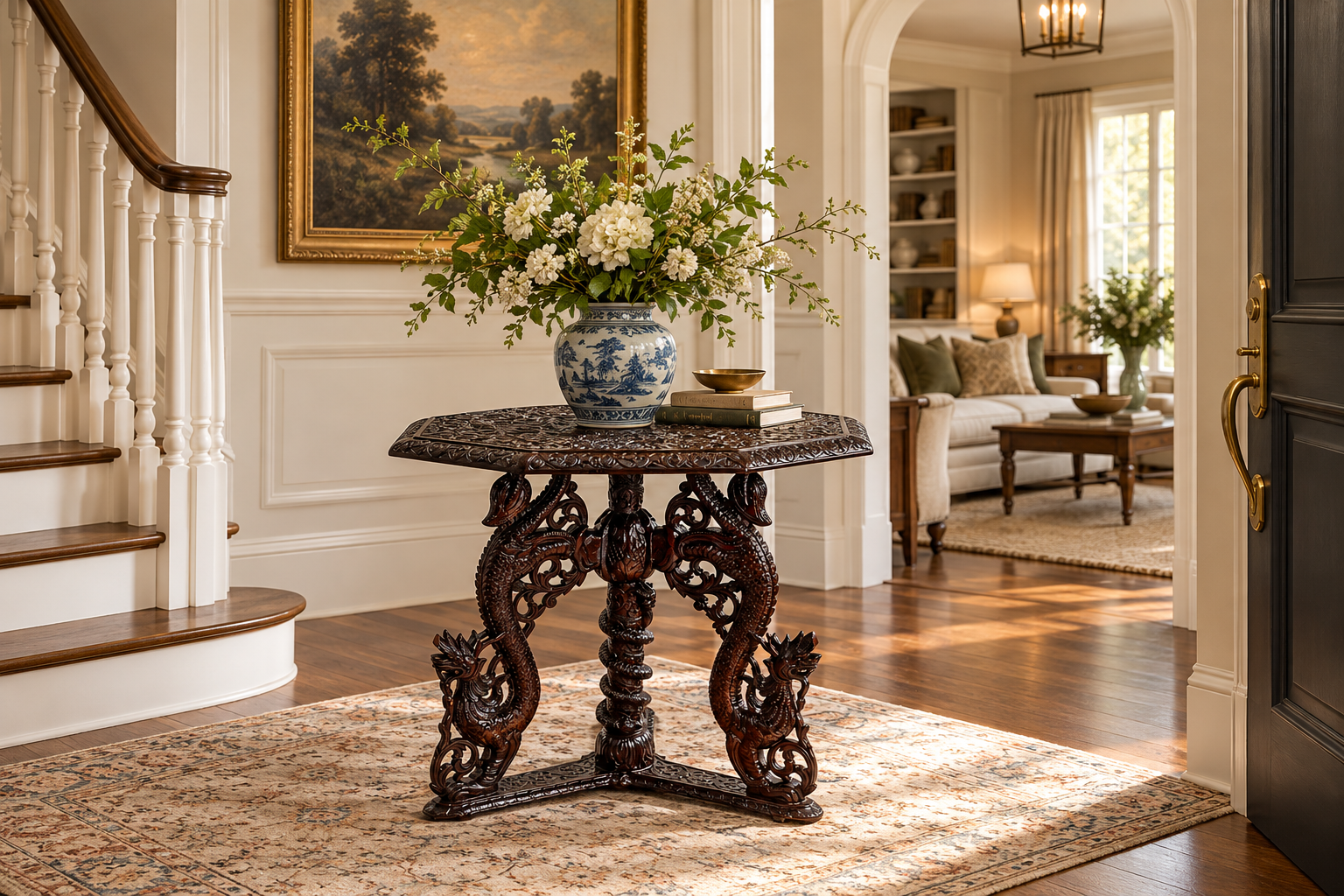
AI-generated room setting for inspiration. Shop this antique Burmese carved dragon and serpent table, 19th century.
An entryway offers an opportunity to introduce antique furniture without requiring a large collection.
A small period table, chest, or stand can establish character immediately upon entering the home.
Consider an antique stand beneath a mirror, accompanied by a simple lamp and a ceramic vessel.
Our Federal Period Ladies Work Table, c. 1820 suggests the elegance that a smaller period piece can contribute to a thoughtfully arranged space.
The surrounding design can remain restrained, allowing the furniture's craftsmanship and proportions to provide the principal interest.
An entryway need not be elaborate to make a lasting impression.
The Bedroom: Comfort and Quiet Character
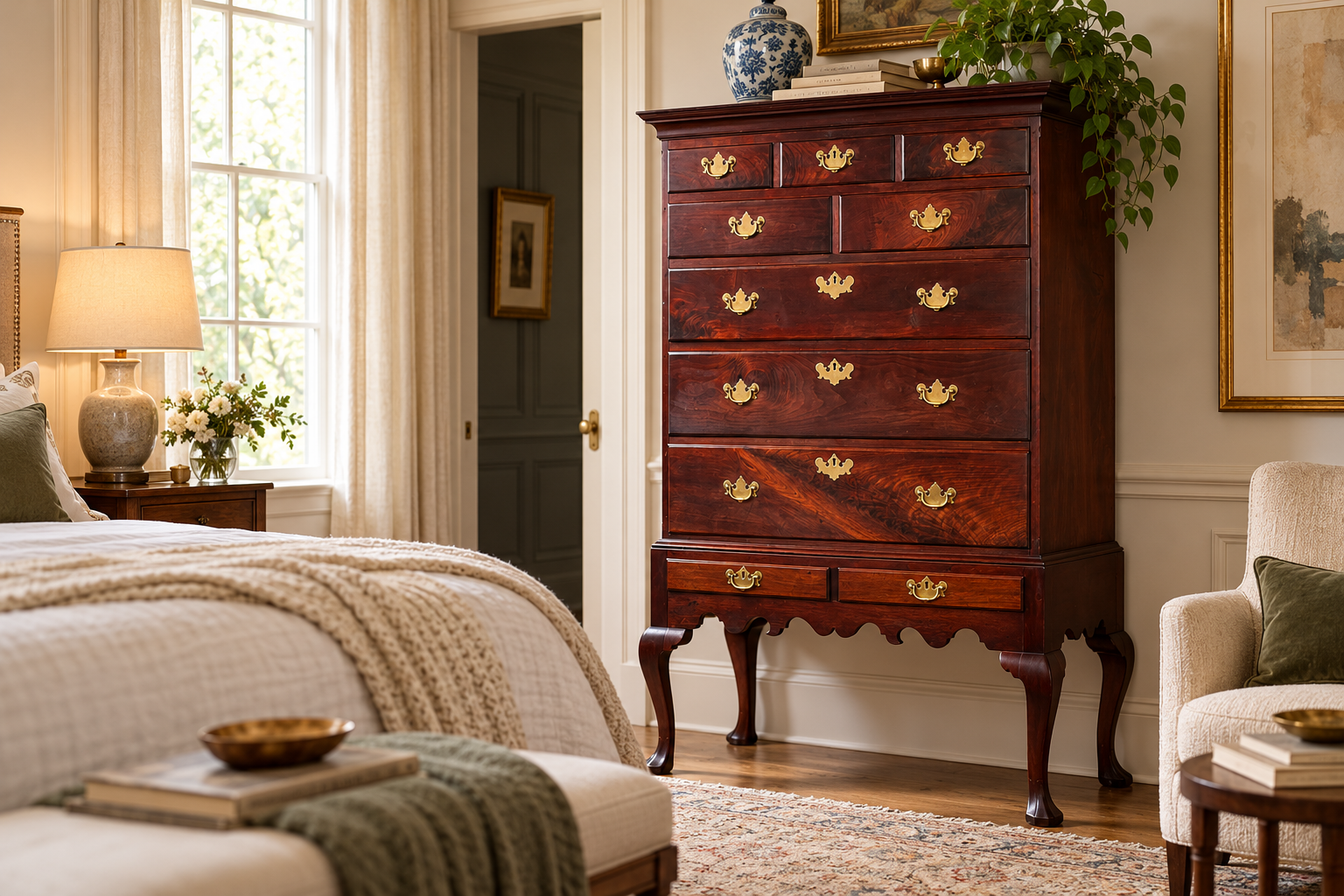
AI-generated room setting for inspiration. Shop this antique Queen Anne walnut chest on frame with drake feet, probably Irish, late 18th century.
Antique chests are especially versatile in bedrooms.
Their practical purpose has changed very little over the centuries, and their rich wood surfaces can bring warmth to rooms otherwise dominated by soft textiles.
A cherry or mahogany chest can sit comfortably alongside a contemporary bed, upholstered headboard, or simple modern lighting.
Layering the room with natural linen, comfortable bedding, and carefully chosen artwork creates a pleasing contrast with the furniture's historic character.
The result can feel serene rather than formal.
This is one of the enduring strengths of good antique furniture: it does not need elaborate surroundings to be appreciated.
The Beauty of Patina and Imperfection
There is another quality that distinguishes genuinely old furniture from contemporary reproductions.
It has lived.
A two-hundred-year-old chest may bear subtle wear around its drawer pulls, variations in the color of its surface, or evidence of a carefully executed repair made generations ago.
These details may seem insignificant when considered individually, but together they contribute to an object's character.
Collectors often describe this accumulated visual history as patina.
We believe patina is among the most compelling qualities of antique furniture.
A softly worn surface can bring warmth to a room filled with crisp contemporary finishes. The irregularities of handmade construction can provide a welcome counterpoint to the precision of modern manufacturing.
Of course, patina should not be confused with every form of damage.
Structural instability, inappropriate alterations, or serious condition issues deserve careful evaluation.
But an antique does not need to look new to be beautiful.
In fact, attempting to eliminate every sign of age can remove precisely the character that made the piece desirable in the first place.
We discuss this distinction in greater detail in our Guide to Buying Antique Furniture Online with Confidence, where we explore authenticity, condition, restoration, and the importance of informed purchasing.
The appeal of historic furniture lies partly in the knowledge that its story began long before ours.
Buying Antiques with Intention
We believe the most satisfying interiors develop gradually.
Not every space needs to be completed immediately, and not every object needs to arrive as part of a coordinated collection.
Sometimes a home becomes more interesting when its furnishings are chosen one remarkable piece at a time.
This approach is particularly well suited to antique furniture.
Unlike mass-produced furnishings, period antiques offer tremendous variety in their proportions, construction, woods, regional characteristics, and history.
A New England cherry chest differs meaningfully from an English mahogany chest of similar age. A Federal stand communicates an entirely different design sensibility from an American Empire table.
Understanding these distinctions makes the process of furnishing a home more rewarding.
For those interested in exploring the history behind these forms, our Guide to American Federal Furniture and Guide to English Georgian Furniture provide a deeper look at the design traditions that shaped them.
When selecting an antique, we encourage buyers to consider both beauty and usefulness.
Choose pieces whose proportions you admire, whose construction and condition you understand, and whose character speaks to you.
Consider how they might serve your home today rather than attempting to reproduce the interiors in which they originally appeared.
A good antique should contribute something lasting to a room.
It should also be something you genuinely enjoy living with.
A Home Collected Over Time
Perhaps what we appreciate most about antique furniture is the way it connects the past to the present without requiring us to choose between them.
An eighteenth-century table can sit beneath a modern painting. A Federal cherry chest can stand beside a contemporary sofa. A Georgian secretary can hold books, photographs, and objects that tell the story of a family living in an entirely different century.
The furniture does not become less meaningful because its surroundings have changed.
In many ways, it becomes more interesting.
These pieces remind us that a home is not simply a collection of objects purchased to achieve a particular look.
It is an evolving expression of the people who live there, the things they value, and the stories they choose to preserve.
At Pearl City Antiques, we have a particular affection for early American and English brown furniture because we believe its beauty has never depended on fashion.
Its appeal lies in craftsmanship, proportion, rich natural materials, and the unmistakable character that comes with age.
And when these qualities are combined thoughtfully with the comforts and creativity of modern living, something wonderful happens.
The room no longer feels old or new.
It simply feels like home.
Greg & Jessi
Pearl City Antiques
Discover Antique Furniture for Your Home
At Pearl City Antiques, we specialize in carefully selected American and English antique furniture, along with vintage furnishings and decorative objects.
Whether you're searching for a statement piece or a smaller antique to bring warmth and individuality to a room, we invite you to explore our changing collection.
Explore the Collection at Pearl City Antiques
Questions about a particular piece? We're always happy to discuss condition, dimensions, attribution, and nationwide delivery arrangements.
END OF ARTICLE</Writing


