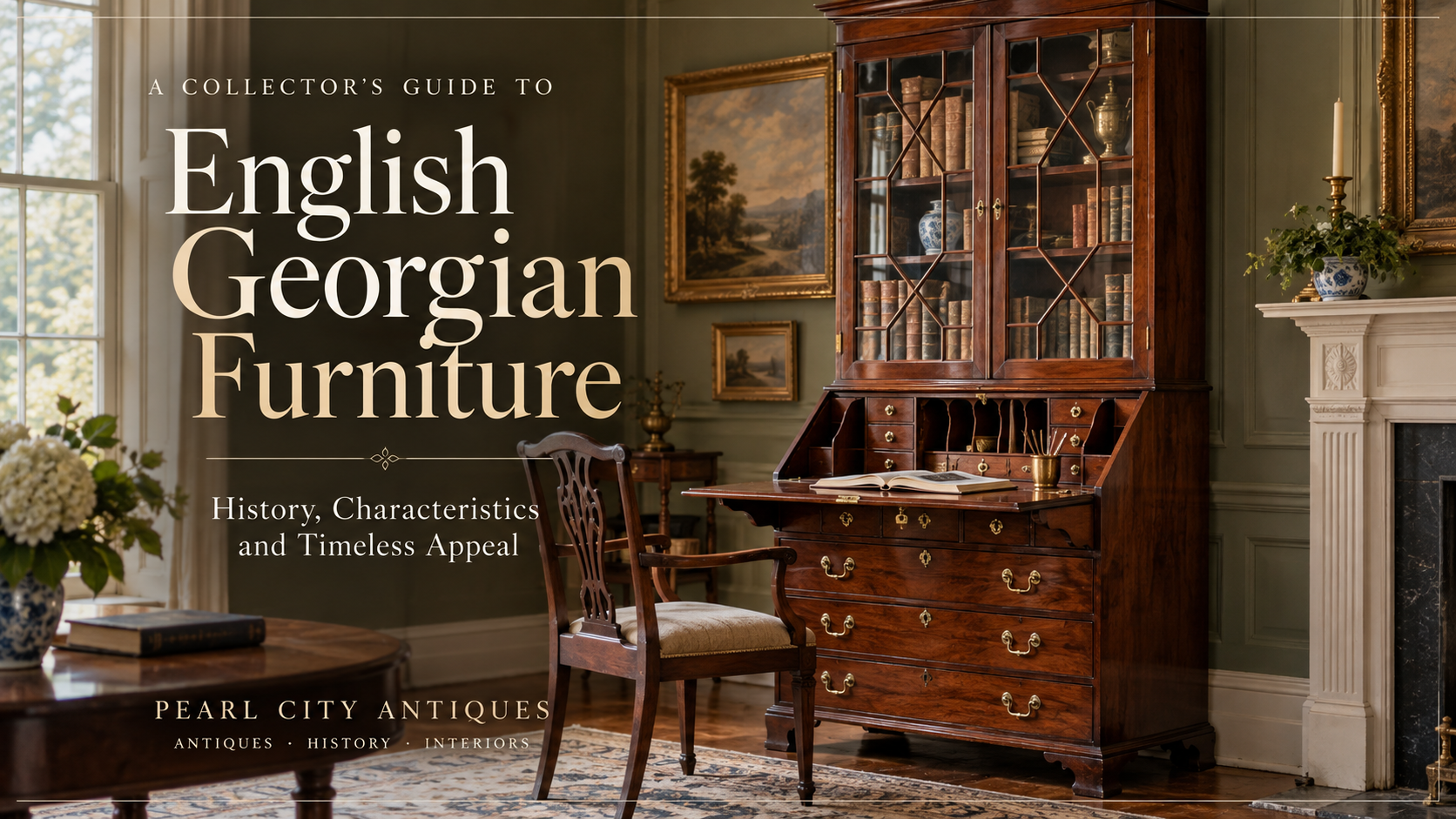
Few terms in antique furniture encompass as much history as Georgian.
The Georgian era stretched from the accession of George I in 1714 through the death of George IV in 1830—more than a century during which English furniture changed dramatically.
For that reason, Georgian furniture is not a single style.
The substantial forms of the early eighteenth century, the Rococo and Chippendale designs of the mid-century, the refined Neoclassicism associated with Robert Adam, George Hepplewhite, and Thomas Sheraton, and the bolder classical furniture of the Regency period can all belong to the Georgian story.
What connects them is not a single leg, wood, or decorative motif. It is their place within an extraordinary period of English cabinetmaking in which changing architecture, international trade, archaeology, fashion, and domestic life continually reshaped furniture design.
At Pearl City Antiques, much of the English Georgian furniture we encounter dates from the reigns of George II and George III, extending into the Regency period. Those objects provide a tangible way to understand how Georgian furniture evolved—and why the term requires more nuance than a simple list of identifying characteristics.
Explore Georgian furniture currently available at Pearl City Antiques
A Century of Georgian Furniture
A simple chronology helps make sense of the period:
1714 — George I becomes king
1727 — George II
1754 — Thomas Chippendale publishes the first edition of The Gentleman and Cabinet-Maker's Director
1760 — George III
1760s onward — Neoclassical design grows increasingly influential in Britain
1788 — The Cabinet-Maker and Upholsterer's Guide associated with George Hepplewhite is published
1791 onward — Thomas Sheraton publishes The Cabinet-Maker and Upholsterer's Drawing-Book
1811–1820 — The political Regency
1820 — George IV
1830 — End of the Georgian era
These dates provide landmarks, not walls.
Furniture styles overlapped. Older forms persisted after newer fashions appeared. Craftsmen outside London interpreted fashionable designs differently from elite metropolitan workshops. Customers continued ordering familiar forms even as taste changed around them.
Understanding Georgian furniture therefore requires looking at continuity as well as change.
Why Georgian Furniture Is Not One Style
The word Georgian describes a historical era more readily than it describes a single design vocabulary.
A mahogany desk made during the reign of George II can look remarkably different from a satinwood Sheraton-influenced table made during the reign of George III, yet both can legitimately be Georgian furniture.
During the Georgian century, English furniture absorbed influences from:
- Baroque design
- Palladian architecture
- Rococo ornament
- Gothic design
- Chinese and East Asian decorative traditions
- Greek and Roman antiquity
- French Neoclassicism
- Egyptian and archaeological influences
At the same time, English cabinetmakers continually adapted those fashionable ideas to practical furniture intended for dining, writing, entertaining, sleeping, dressing, reading, and storage.
That combination of changing fashion and practical domestic life is one reason Georgian furniture became so varied.
George I and Early Georgian Furniture
When George I came to the British throne in 1714, English furniture did not suddenly become "Georgian."
Cabinetmakers continued traditions developed during the late seventeenth and early eighteenth centuries. Walnut remained important, curved forms persisted, and furniture retained strong connections to the Queen Anne and earlier Baroque traditions.
Early Georgian furniture could be substantial and architectural, with strong proportions and relatively restrained ornament. Cabriole legs, shaped aprons, veneered surfaces, and walnut case furniture remained important.
During these decades, however, another wood was beginning to transform English furniture.
Mahogany.
Its availability through Britain's expanding Atlantic trade, combined with its strength, stability, rich color, and ability to hold both carving and a fine polished surface, helped make mahogany one of the defining materials of Georgian cabinetmaking.
By the middle decades of the eighteenth century, its influence was unmistakable.
George II: Mahogany and Changing Taste
The reign of George II, from 1727 to 1760, saw some of the most important developments in English furniture history.
Mahogany became increasingly prominent in fashionable furniture. Palladian architectural ideas influenced interiors and case furniture, while Rococo ornament introduced greater movement, carving, and visual exuberance.
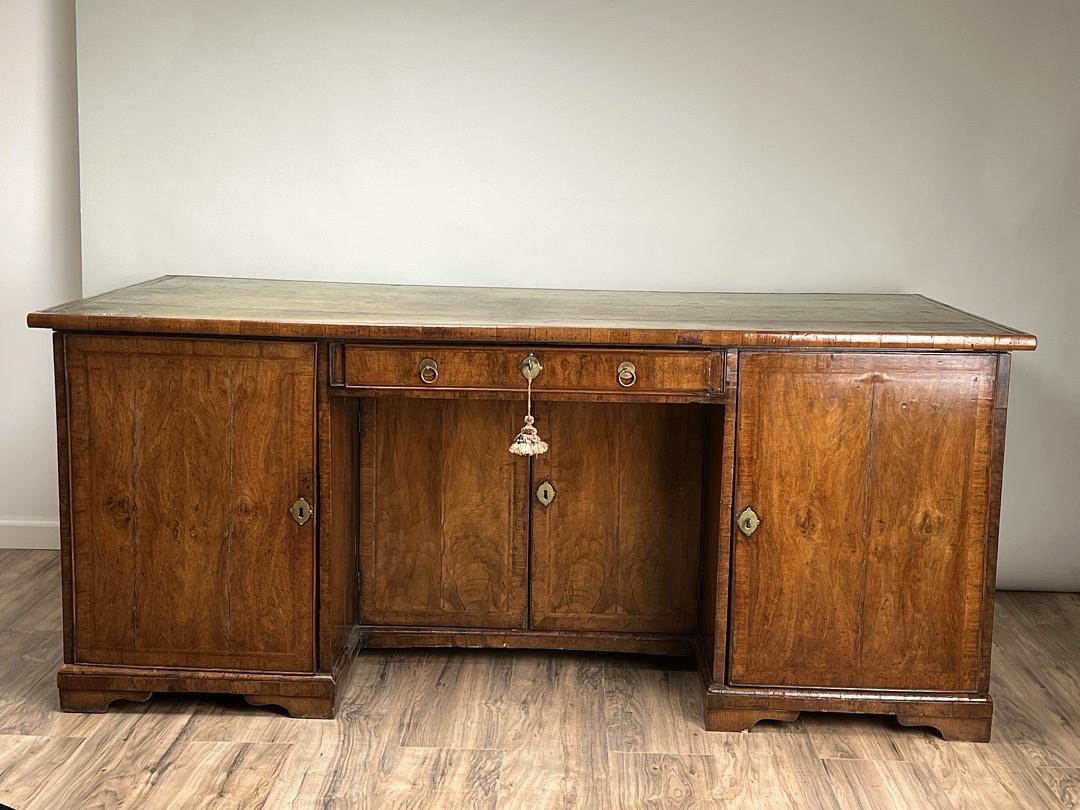
Our large George II mahogany desk, mid-18th century provides a useful object through which to view this period.
Its substantial scale and mahogany construction illustrate a very different expression of Georgian furniture from the lighter Neoclassical pieces that would become fashionable later in the century.
This is an important point.
When someone asks, "What does Georgian furniture look like?" there is no single correct silhouette.
The answer depends considerably on when during the Georgian era the furniture was made, where it was made, who made it, and for whom it was intended.
Thomas Chippendale and the Mid-Georgian Design Vocabulary
Few names are more closely associated with eighteenth-century English furniture than Thomas Chippendale.
Yet "Chippendale" is often used far too loosely.
Chippendale was a London cabinetmaker, designer, and businessman whose influence was greatly expanded by the publication of The Gentleman and Cabinet-Maker's Director in 1754.
The Director did not present one narrow "Chippendale style." Its designs drew from several fashionable vocabularies, including Rococo, Gothic, and Chinese-inspired forms, alongside more restrained domestic furniture.
That helps explain why genuine Chippendale-period furniture can look so varied.
It also explains why the term should not automatically be interpreted as a maker attribution.
A chair described as Chippendale-influenced may use forms or decorative ideas associated with Chippendale's published designs without having been made in his workshop.
Our George III Chippendale-influenced open armchair demonstrates how that design vocabulary could persist into a later period.
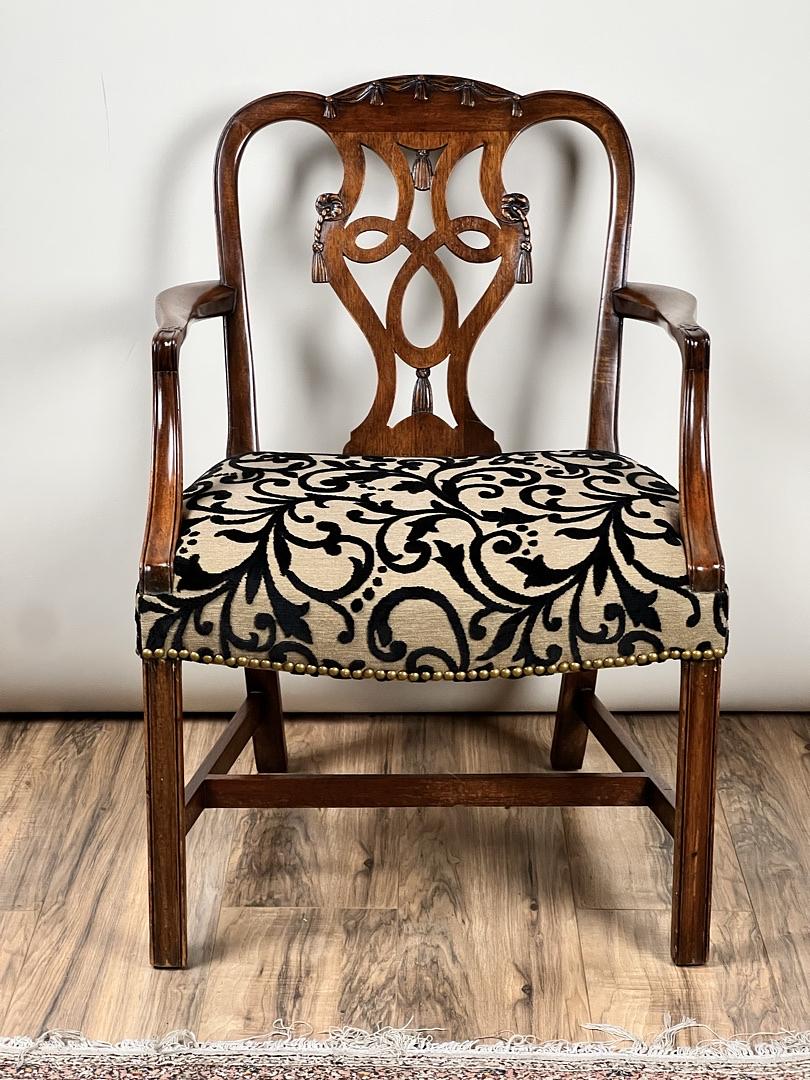
The chair's pierced splat, shaped crest, open arms, and traditional Georgian form connect it visually to the Chippendale tradition even though it dates later than the first flourishing of Chippendale's influence.
Styles rarely disappear simply because a newer fashion has arrived.
George III: Sixty Years of Changing Furniture
George III reigned from 1760 until 1820.
That sixty-year span alone should warn us against thinking of "George III furniture" as one style.
Furniture made near the beginning of his reign can retain strong Chippendale and Rococo influences. By the later eighteenth century, Neoclassical design had transformed fashionable English interiors. By the final decades of George III's reign, the forms we associate with Regency were already developing.
Our George III mahogany secretary bookcase, late 18th century represents the sophisticated case furniture produced during this long period.
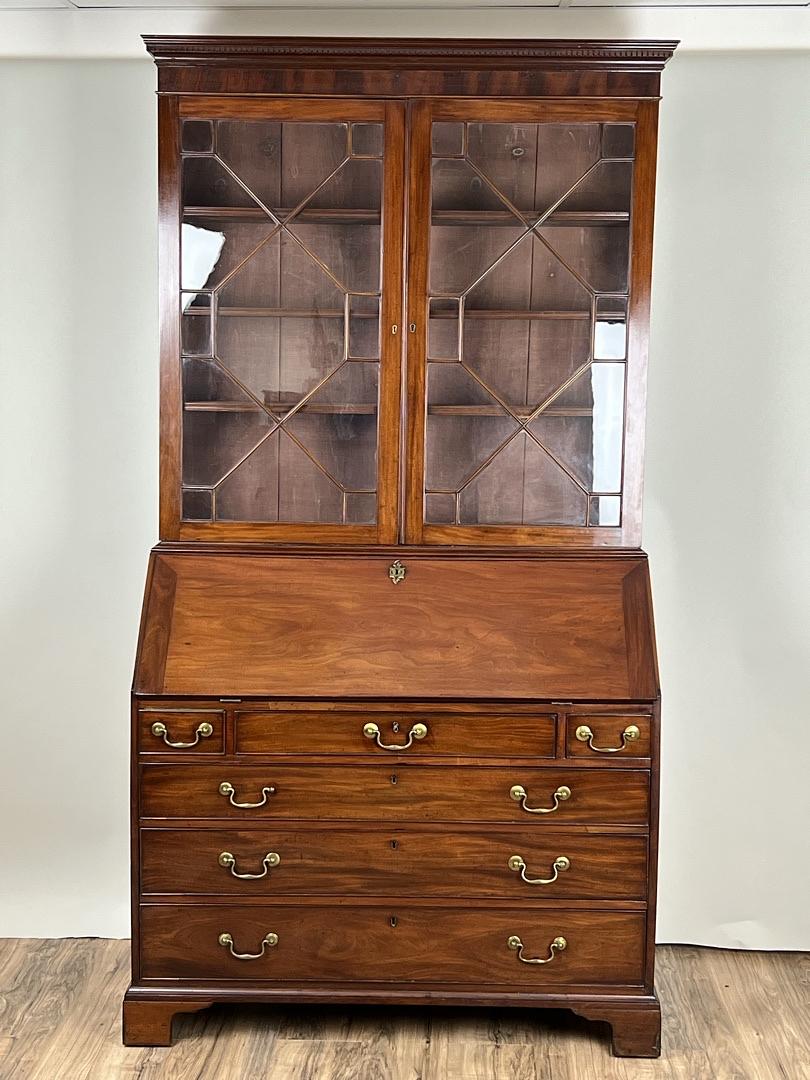
Its architectural scale, mahogany casework, storage, bookcase, and writing functions demonstrate how Georgian furniture could combine imposing visual presence with highly practical use.
A much smaller object can tell an equally important story.
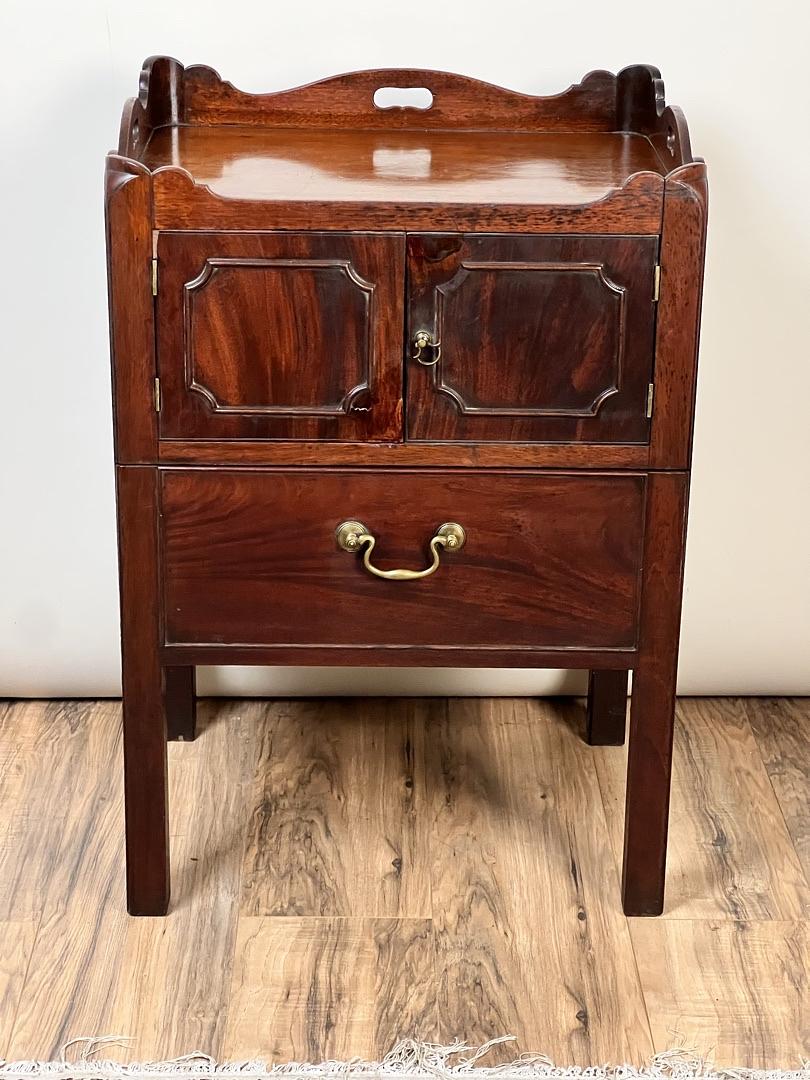
Our George III mahogany bedside commode with pull-out leather writing surface, late 18th century reveals another side of Georgian cabinetmaking: furniture designed around the rituals of everyday domestic life.
That piece leads us to an aspect of Georgian furniture that is sometimes lost when the discussion focuses only on styles and designers.
How Georgians Actually Used Their Furniture
Furniture is evidence of how people lived.
Georgian households developed an extraordinary variety of specialized furniture forms.
There were tables specifically intended for tea, cards, dining, writing, sewing, and occasional use. Secretaries combined writing surfaces with storage and bookcases. Washstands supported personal grooming. Bedside commodes addressed needs that modern plumbing later made obsolete. Pembroke tables could expand when needed and occupy little space when not.
Furniture moved through rooms and served particular social rituals.
Tea drinking became an important part of domestic and social life. Card playing required specialized tables. Writing and correspondence created demand for desks, secretaries, and writing tables. Increasing numbers of books created demand for bookcases and library furniture.
Our George III bedside commode is especially useful because its original function is no longer necessary, yet the piece remains remarkably practical.
Today it can serve beautifully as a nightstand, side cabinet, or small writing surface.
That adaptability is one reason Georgian furniture remains so livable.
Original function does not have to dictate modern use.
The Neoclassical Turn: Adam, Hepplewhite, and Sheraton
During the second half of the eighteenth century, British taste increasingly turned toward Neoclassicism.
Renewed European fascination with the ancient Greek and Roman world—encouraged in part by archaeological discoveries at Herculaneum and Pompeii—changed architecture, interiors, and furniture.
The work of architect and designer Robert Adam helped introduce lighter, more unified Neoclassical interiors in which architecture, furniture, plasterwork, carpets, and decorative arts were conceived as parts of a coordinated whole.
Furniture became increasingly refined in proportion.
Straight and tapered legs became more prominent. Delicate inlays, contrasting veneers, painted decoration, and classical motifs replaced some of the heavier carving and movement associated with earlier Rococo design.
Two names became particularly influential in this later Georgian vocabulary:
George Hepplewhite and Thomas Sheraton.
Hepplewhite-associated designs are often recognized for graceful proportions, tapered legs, shield- or oval-back chairs, serpentine and bow-front forms, and restrained Neoclassical decoration.
Sheraton-associated furniture frequently appears somewhat more rectilinear and architectural, with straight tapered or turned legs, reeding, contrasting veneers, and carefully organized geometric forms.
As with Chippendale, these names are best understood as important design influences, not automatic maker attributions.
The influence of this British Neoclassical furniture would extend far beyond England.
It would become particularly important in the development of American Federal furniture.
Read our Guide to American Federal Furniture, c. 1780–1830
Georgian Furniture and American Federal Furniture
Georgian and Federal furniture are closely related, but they are not interchangeable terms.
Georgian refers broadly to British furniture produced during the Georgian era and to the evolving English design traditions associated with that period.
Federal describes an American historical and design context emerging after the American Revolution.
American cabinetmakers were strongly influenced by British designers including Hepplewhite and Sheraton, as well as the broader Neoclassical movement.
But they interpreted those influences through American materials, regional cabinetmaking traditions, and the cultural context of the new republic.
A late George III English piece and an American Federal piece may therefore share tapered legs, inlay, contrasting veneers, and Neoclassical proportions while belonging to different national traditions.
Understanding one helps illuminate the other.
Woods and Materials in Georgian Furniture
Wood is central to the character of Georgian furniture.
Walnut
Walnut remained particularly important in early Georgian furniture, continuing traditions established during the late seventeenth and Queen Anne periods.
Mahogany
By the middle decades of the eighteenth century, mahogany had become one of the defining materials of fashionable English furniture.
Its strength allowed cabinetmakers to create thinner structural elements and ambitious carved forms, while its rich color and grain produced beautiful polished surfaces.
The George II desk, George III secretary, and George III commode we've handled all demonstrate how central mahogany became to English cabinetmaking.
Satinwood and Figured Veneers
Later Georgian Neoclassical furniture often made sophisticated use of lighter woods, figured veneers, crossbanding, and contrasting inlays.
Decoration could increasingly come from the arrangement and natural figure of the wood rather than carving alone.
Secondary Woods
As with American furniture, the woods hidden inside Georgian case furniture can be informative.
Drawer sides and bottoms, backboards, interior framing, and other secondary construction may provide evidence about workshop practice, age, and origin.
They should never be interpreted in isolation.
Period, Style, and Attribution
Antique furniture terminology becomes confusing when different kinds of labels are treated as though they mean the same thing.
They do not.
George II and George III primarily describe historical reigns.
Georgian describes the broader era and traditions associated with it.
Chippendale, Hepplewhite, and Sheraton can describe designers, published design vocabularies, or stylistic influence.
Regency can describe both a specific political period and a broader furniture style.
And Georgian style can describe furniture made long after the Georgian era.
For example, a nineteenth- or twentieth-century chair might accurately be described as Chippendale style while being far too late to have been made during Chippendale's lifetime.
That does not make the later piece bad furniture.
It simply makes accurate language important.
At Pearl City Antiques, we try to distinguish between when a piece was made, the design tradition it belongs to, and what we can actually support about its maker or origin.
The goal is not to attach the most prestigious possible name to a piece.
The goal is to describe what the evidence supports.
How We Evaluate Georgian Furniture
When we examine an English Georgian piece, we look at the object as a whole.
Construction
Joinery, drawer construction, backboards, drawer bottoms, interior framing, and case construction can all provide evidence.
Hand-cut dovetails may support an early date, but dovetails alone do not authenticate furniture. Techniques persisted, workshops differed, and later craftsmen reproduced older methods.
Woods
Primary and secondary woods can provide important clues.
We consider not only what wood is visible but how different woods were used throughout the piece.
Hardware
Brass pulls, handles, locks, hinges, and escutcheons can contribute evidence, but hardware is frequently replaced.
We look for plugged holes, shadows from earlier backplates, differences in oxidation, and other evidence of change.
Replacement hardware does not erase an antique's history. It should simply be identified when possible.
Surface and Wear
Old furniture develops evidence of use.
Oxidation, shrinkage, wear, tool marks, old surfaces, repairs, and differences between protected and exposed areas can all contribute to understanding an object.
But age does not mean untouched.
A piece of Georgian furniture may have survived two or three centuries of use, and repairs can themselves become part of its history.
Proportion and Design
Perhaps most importantly, the piece must make sense as a whole.
Construction, materials, proportions, decorative vocabulary, and evidence of age should tell a coherent story.
No single characteristic establishes authenticity.
Good evaluation comes from accumulated evidence.
Regency: The Georgian Era's Final Transformation
The Regency presents another terminology challenge.
The political Regency lasted from 1811 to 1820, when the future George IV governed as Prince Regent during the illness of George III.
But furniture historians often use Regency more broadly to describe British design of the early nineteenth century.
And Regency furniture developed while Britain was still very much in the Georgian era.
Our English Regency upholstered armchair, c. 1820 sits almost perfectly at that historical intersection.
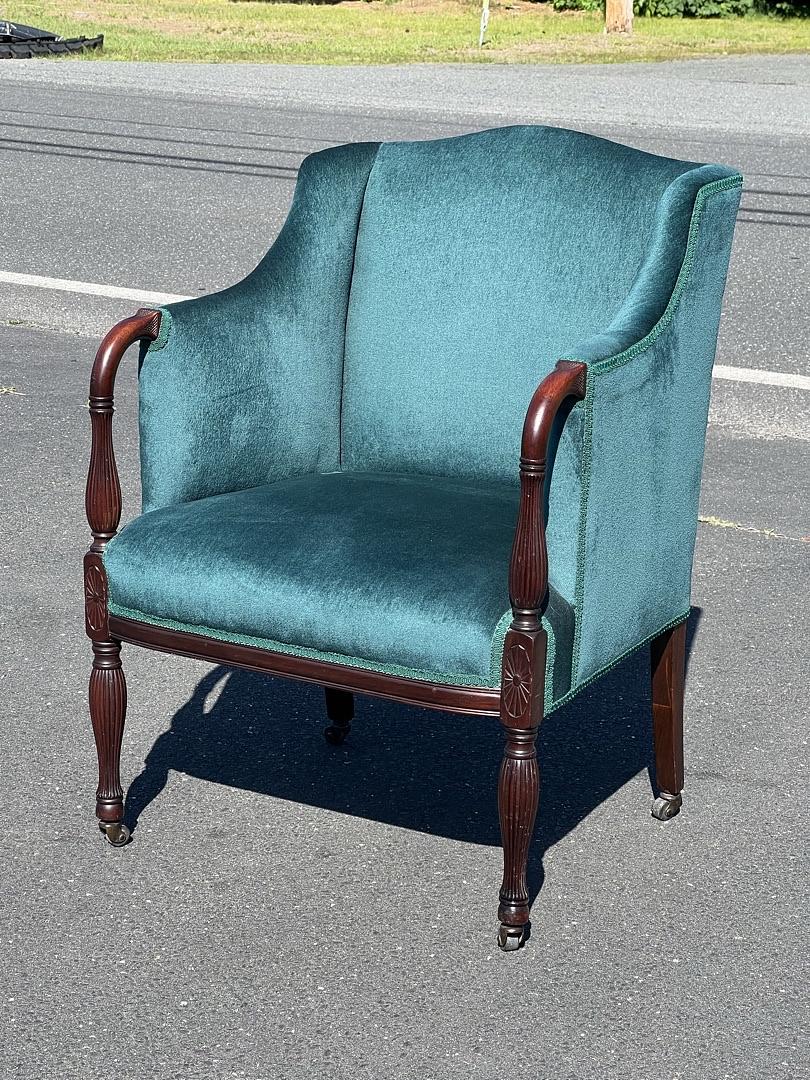
By this period, classical inspiration had become increasingly archaeological and visually assertive.
Greek, Roman, Egyptian, and other ancient sources influenced furniture design. Forms could become bolder and more architectural. Saber legs, reeding, brass details, classical profiles, and ancient furniture prototypes increasingly appeared.
The transition was gradual.
There was no morning when Georgian furniture ended and Regency furniture began.
Regency is best understood as part of the final transformation of Georgian design—and as the beginning of another chapter in British furniture history.
Living With Georgian Furniture Today
Georgian furniture was made for houses very different from ours.
Yet good Georgian furniture remains remarkably easy to live with.
A George III commode can become a bedside table.
A Georgian chest can provide storage in a bedroom or living room.
A small writing table can sit beside contemporary upholstery.
A secretary can become the architectural anchor of an office or library.
And a Georgian chair can introduce history and sculptural form without requiring the rest of the room to follow it.
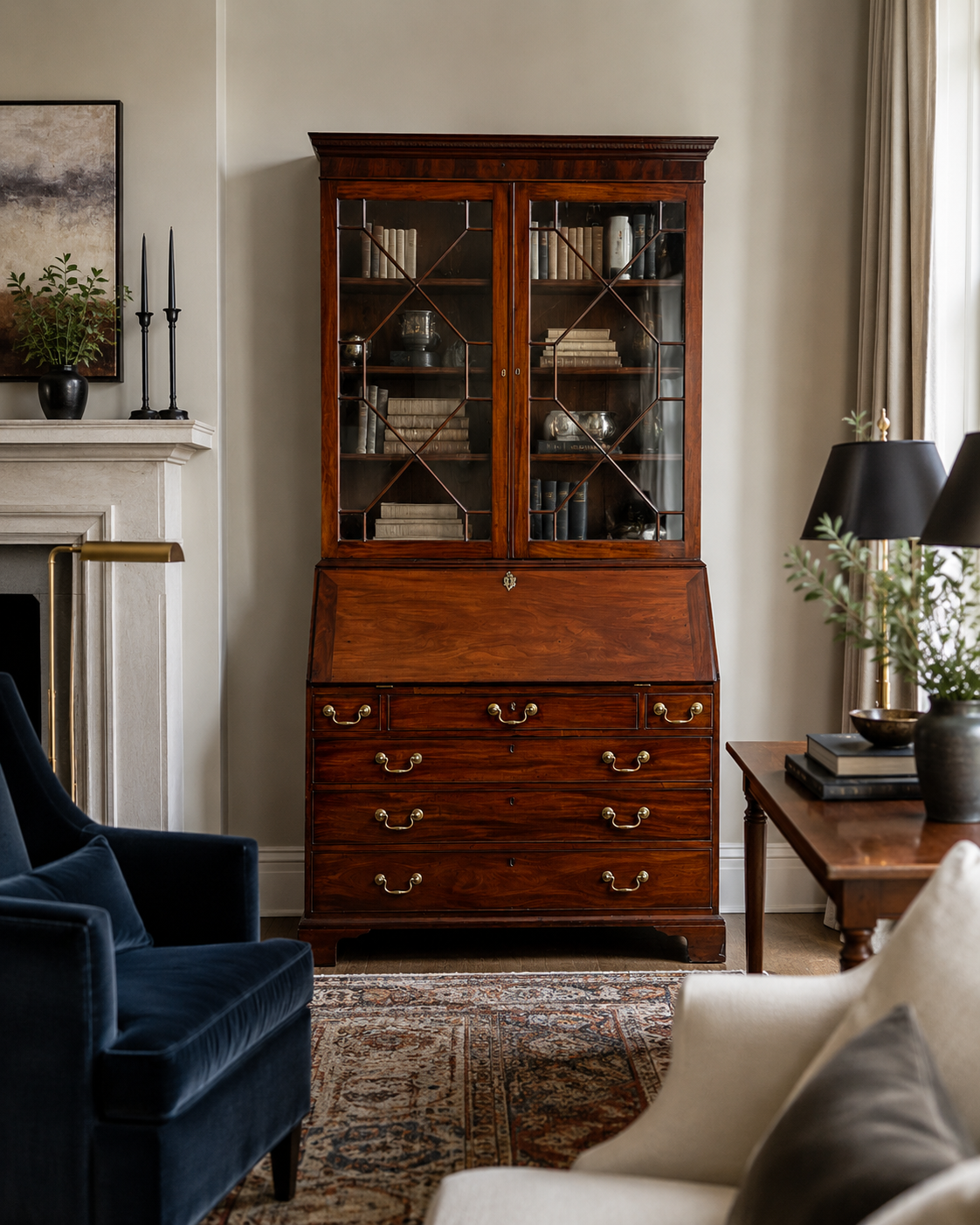
Antiques do not require period rooms.
In fact, Georgian furniture's emphasis on proportion, natural materials, useful forms, and craftsmanship can make it particularly effective beside contemporary furniture.
A room containing objects from different periods can feel collected rather than decorated all at once.
We believe that is often where antiques are most compelling.
The furniture brings its history with it.
The new owner decides what happens next.
Explore Georgian Furniture at Pearl City Antiques
The Georgian furniture we handle ranges from substantial mid-eighteenth-century mahogany pieces through refined George III furniture and into the Regency period.
Each object provides another opportunity to study how English furniture changed across more than a century.
Because genuine antiques are unique, the available inventory continually changes.
Explore our current collection of Georgian furniture.
Pieces that have already found new homes remain valuable as reference objects. Their photographs, construction details, labels, repairs, and histories can continue helping us—and others—understand the furniture long after the object has left our care.
Over time, we hope that record becomes increasingly useful to collectors, designers, and anyone interested in the history of English furniture.
An Ongoing Story
The Georgian era witnessed extraordinary change.
Across more than a century, English furniture evolved from the substantial forms of the early eighteenth century through the exuberance of Rococo and Chippendale design, into the refined proportions of Neoclassicism, and finally toward the increasingly archaeological and expressive forms of the Regency period.
Yet the best Georgian furniture is more than a record of changing fashion.
These pieces were made for people.
Desks held correspondence and accounts. Tea tables opened for conversation and hospitality. Secretaries stored books and papers. Chairs gathered around dining tables and fireplaces. Commodes, washstands, worktables, and countless other specialized forms served the ordinary rhythms of domestic life.
That human connection is part of what makes Georgian furniture so compelling today.
A mahogany desk made during the reign of George II has survived generations of owners, changing homes, changing tastes, repairs, and everyday use. Its original purpose remains visible, but its story did not end with the household for which it was first made.
That is how we think about antiques at Pearl City.
We value the history, craftsmanship, materials, and evidence that allow us to understand an object as accurately as we can. We believe repairs and changes should be acknowledged rather than hidden, and that period, style, and attribution should describe what the evidence supports rather than what makes the most impressive sales description.
But preservation does not mean freezing furniture in time.
These pieces were made to live in homes, and we believe the best of them should continue to do exactly that.
When a Georgian secretary becomes part of a new library, a commode becomes a bedside table, or a chair made two centuries ago sits comfortably beside contemporary furniture, another generation becomes part of the object's history.
The Georgian era ended in 1830.
The stories of its furniture did not.


